


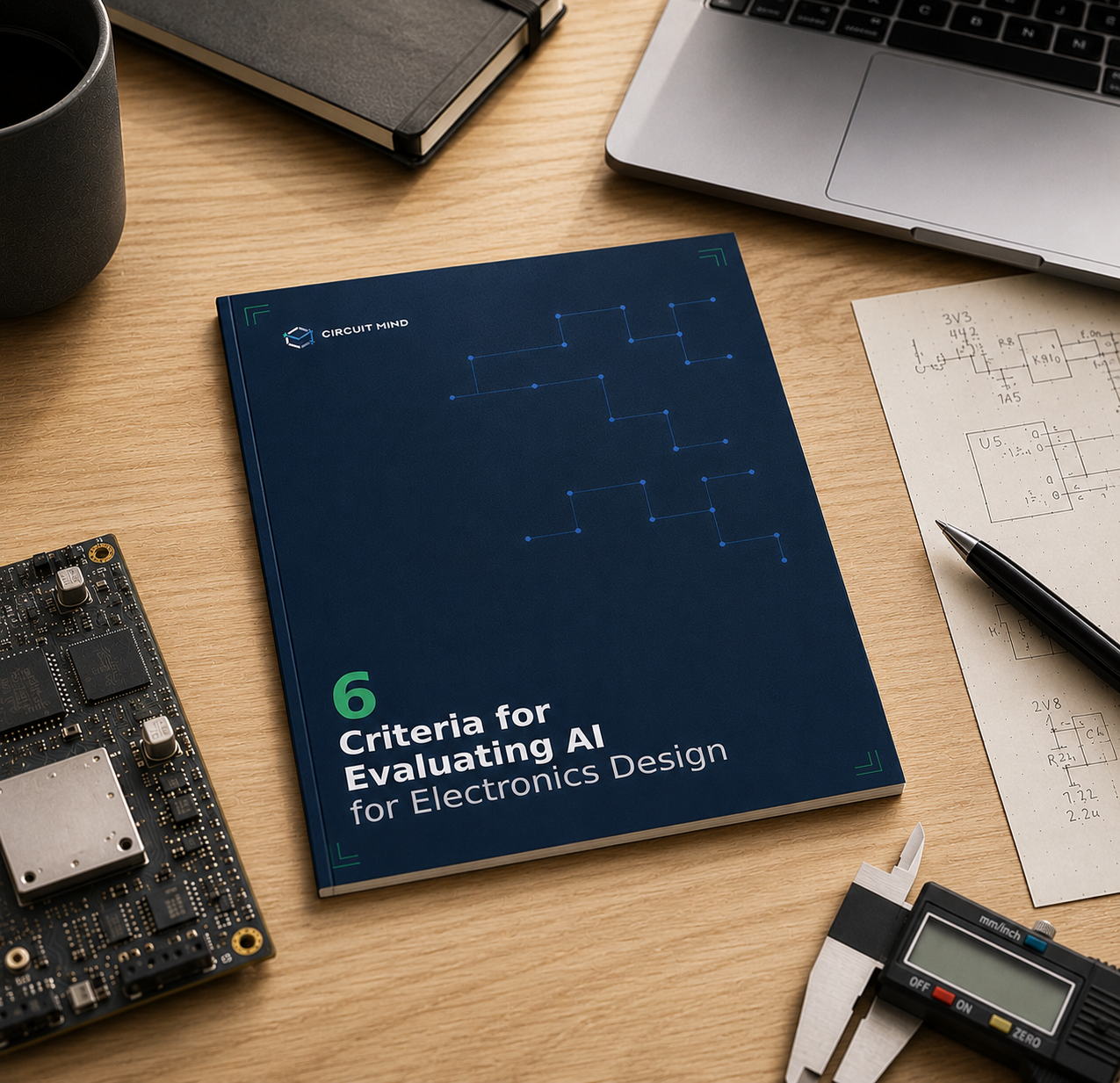
Hardware engineering is under pressure to ship more designs, support more variants, and hit shorter cycles with the same headcount they had years ago. AI promises relief: compressed design cycles, senior engineers freed from routine work, designs optimized for cost, size, and power. But hardware engineering is structurally different from software, and most AI tools weren't built for the physics or the organizational realities of how electronics actually get designed.
This guide gives engineering leaders a practical framework for separating serious AI partners from the rest. Inside, you'll find the six criteria to bring to any evaluation:
- Domain Expertise — why generic AI fails on the physics of circuits, and what purpose-built component modeling looks like.
- Accuracy & Defensibility — how to protect against hallucinations and produce artifacts you can defend in design review.
- Enterprise Workflow Integration — making AI respect your engineering DNA: AVLs, design rules, ECAD libraries, PLM/ERP, and your stage-gate process.
- Platform Evolution — choosing a partner that evolves with the state of the art instead of locking you into yesterday's approach.
- Trust & Security — protecting your IP, from "never train on your designs" to air-gapped and GovCloud deployment.
- Validated Outcomes — why independent, third-party validation carries more weight than vendor self-reporting.
Circuit Mind has spent seven years building electronic design intelligence, combining deterministic algorithms and agentic AI, with patented design-generation technology, the COMMODORE digital twin database, and outcomes independently validated by Los Alamos National Laboratory.
Enter your work email to get the full evaluation guide.


.png)
.png)
.png)
.png)
.png)
.png)


