


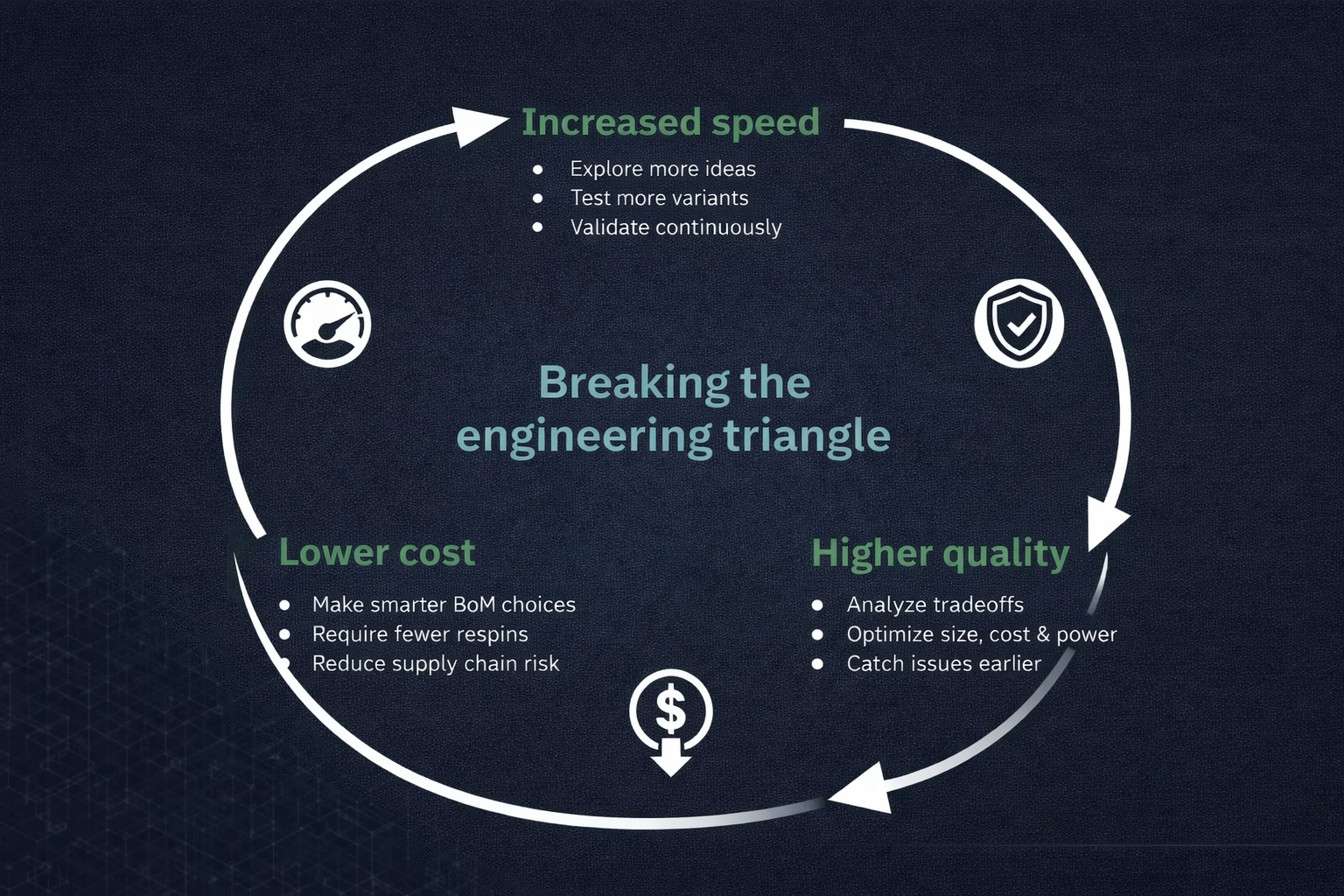
For decades, hardware engineering has lived under an accepted rule:
“Better, faster, cheaper — pick two.”
It’s a rule reinforced by experience, missed deadlines, late-stage respins, and by the reality that speed often comes at the expense of rigor, and cost reduction often erodes performance or reliability.
For a long time, this tradeoff felt unavoidable, but in 2025, that rule broke. Real engineering teams proved it – on real hardware, under real deadlines, and with real constraints. This was the year AI-assisted electronics design crossed the chasm from a promising idea to a practical, transformative capability.
The most important shift wasn’t that design got faster. but that high-quality design became fast, and cost-optimized, at the same time.
Below are four stories that demonstrate how AI-powered design exploration fundamentally changes the traditional tradeoffs of electronics engineering.

1. Los Alamos National Laboratory – Automating PCB Design for Space Electronics
When the ISR-4 division at Los Alamos National Laboratory – responsible for space electronics and signal processing – set out to accelerate development, improve design quality, and reduce manual engineering burden, we knew the bar would be high.
Their mission is as demanding as it gets: designing electronics that must operate reliably in extreme radiation and space environments, in service of national needs.
LANL evaluated Circuit Mind across two real designs: one “medium-complexity” and one “high-complexity.” What they ultimately published in their peer-reviewed case study inspired our entire team.
Circuit Mind reduced a 60–80 hour design to 4 hours and 13 minutes — a ~95% time reduction.
Just as important, they saved an additional 154 hours on downstream reporting through automation-assisted ICD generation, power analysis, derating, procurement documentation, and FMEA.
What changed for LANL is that schematic capture, component selection, pin mapping, derating analysis, and FMEA templates were all generated using Circuit Mind’s electronics design intelligence.
A sincere thank you to Carrie Mu and Jeffrey Love for the thoughtfulness and rigor you brought to this evaluation.

2. APAGCoSyst – Rapid Design Exploration for an EV Interior Lighting RFP
APAGCoSyst has been crafting sophisticated lighting systems and ECUs since 1954. When they approached us, they were facing an exceptionally tight RFP window for an EV interior lighting project.
Manually, their BoM research and documentation process was expected to take 9 days. Using Circuit Mind, it was completed in 2 days.
But the bigger shift came from AI-powered design exploration.
In minutes, ACE generated three distinct architecture candidates, exploring trillions of possible BoM combinations and revealing cost–performance tradeoffs that manual workflows simply can’t surface.
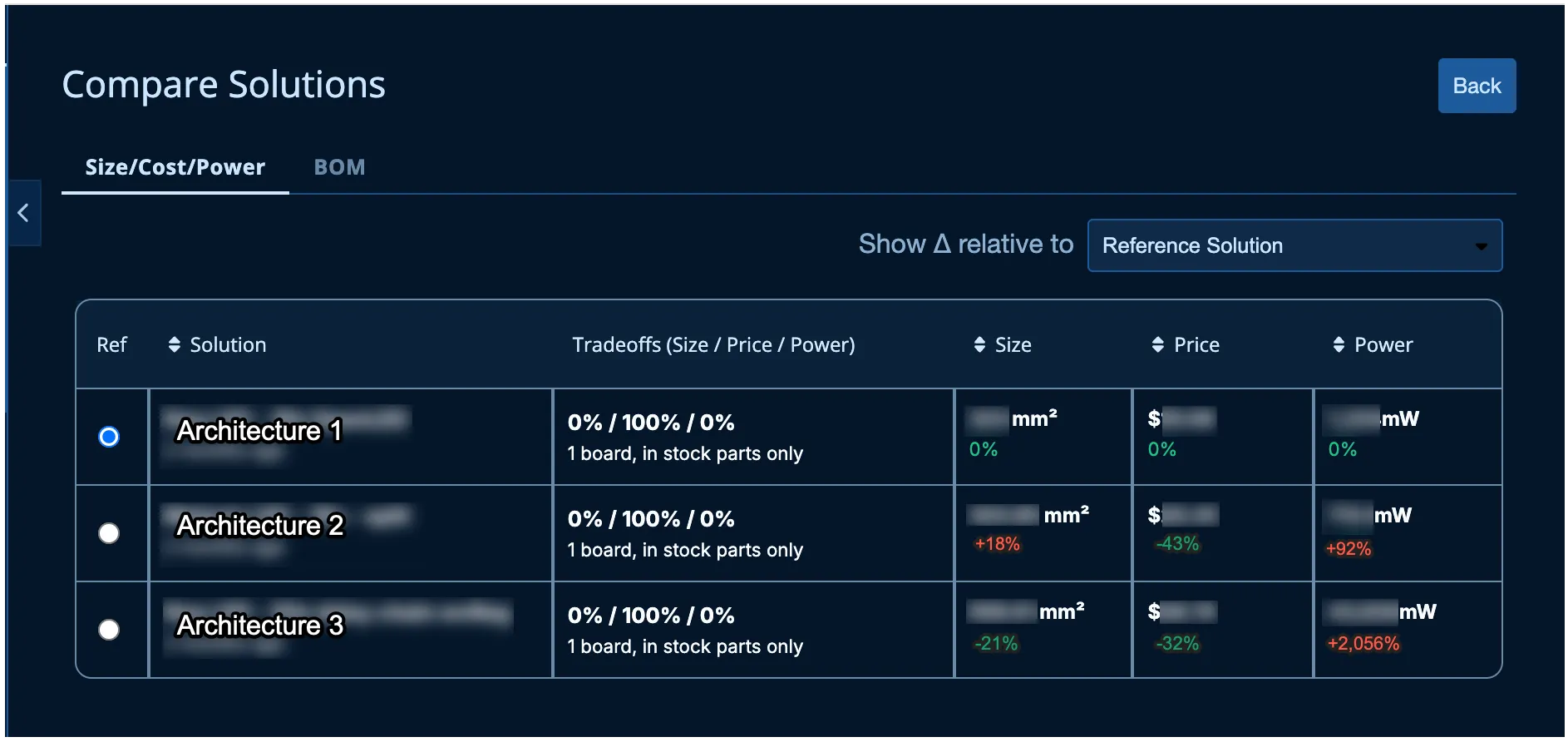
APAG didn’t sacrifice performance to hit cost targets. They didn’t slow down to explore alternatives. They explored more deeply precisely because automation removed the cost of exploration.
Huge thanks to Bernhard Edlinger and the APAGCoSyst team for collaborating with us and sharing your experience.

3. Design1st – Accelerating Prototyping for a Precision Wellness Device
Design1st is one of the most respected product design firms in North America, known for delivering high-quality hardware under intense time pressure.
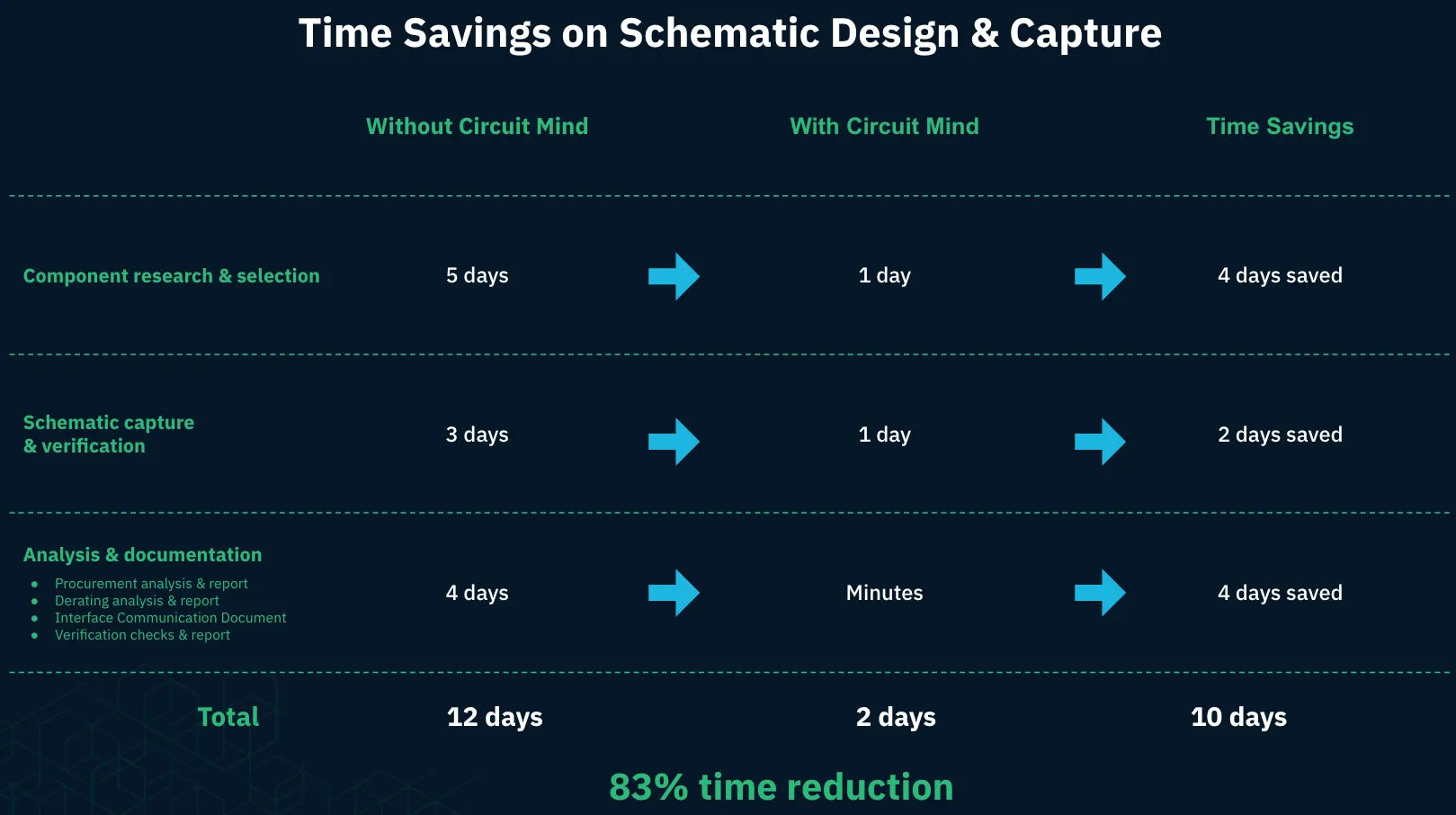
Their first project with Circuit Mind was a precision wellness healthcare device. The conceptual design phase – requirements capture, block diagram, preliminary schematics, and early BoM – was budgeted at 12 days.
With Circuit Mind, it was completed in 2 days.
“The Circuit Mind platform was a game-changer for our wellness project.” Steve Auger, Electronics Design and Engineering Expert, Design1st
When iteration becomes inexpensive, teams don’t cut corners, they widen the solution space. Faster conceptual design didn’t reduce quality; it expanded it.
Thank you to Steve Auger and Donovan Wallace for trusting our team on such a fast-moving, high-impact project.

4. Nextech – Rapid Design of a Remote Command & Control System
Nextech, a leader in digital transformation and advanced product development, set out with a clear objective:
Accelerate development without sacrificing quality.
For an advanced remote command, control, and monitoring system, their team estimated a 12-day design timeline using traditional methods.
With Circuit Mind, they generated multiple architecture variants, compared tradeoffs, and delivered production-ready schematics in just 3 days.
“We needed prototype designs in days, not weeks — without sacrificing quality.” – Mark Furiate, Chief Technology Officer, Nextech
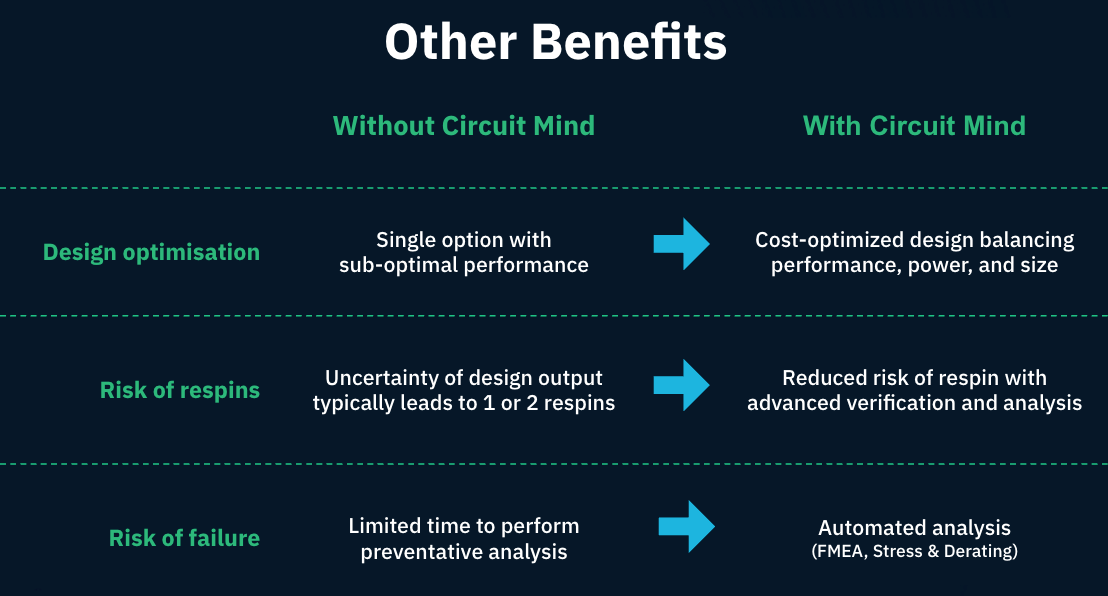
Beyond speed, Mark shared more benefits the team is seeing from Electronics Design Intelligence:
Big thanks to Mark Furiate for your vision and openness to electronics design intelligence.
Better. Faster. Cheaper. Pick Three.
Across these stories, one pattern is unmistakable:
When design exploration becomes fast, deep, and computational – transformation happens.
- Los Alamos proved AI-assisted design can meet extreme reliability requirements without slowing down.
- APAG showed cost-optimized architectures emerge only when exploration scales beyond human limits.
- Design1st demonstrated that faster early design unlocks better downstream decisions.
- Nextech proved production-ready hardware in days is not only possible — it’s repeatable.
These teams didn’t just get designs done faster.
They got designs done better.
For decades, hardware teams treated the engineering triangle as a law of physics. In reality, it was a limitation of tools.
I couldn’t be more proud of what these teams accomplished, and grateful for the trust they placed in us on their hardest, highest-stakes projects.
It’s time to build.


.png)
.png)
.png)
.png)
.png)
.png)


